Denied Aliyah Due to Lack of Proof of Judaism?
One of the most common reasons for delays and refusals under the Law of Return is insufficient proof of Jewish heritage. Many applicants are surprised to discover that family stories, partial records, or informal community recognition may not be enough for Israeli immigration authorities.
Aliyah cases involving missing documents, Soviet-era records, inconsistent family names, adoption histories, or undocumented Jewish ancestry often require careful legal and evidentiary preparation.
Our office assists individuals and families worldwide with complex proof-of-Judaism cases, including applications that were delayed, referred for additional review, or denied by Nativ or the Israeli Ministry of Interior.
Why Do Israeli Authorities Request Additional Proof?
Under the Law of Return, applicants must establish eligibility based on:
- Jewish identity,
- descent from a Jewish parent or grandparent,
- or qualifying family relationships.
Israeli authorities may request additional documentation where:
- records are incomplete,
- family histories are unclear,
- documents conflict with one another,
- or the applicant’s eligibility cannot be verified through standard civil records.
Common Problems in Proof-of-Judaism Cases
Missing Family Documents
Many families, particularly from the former Soviet Union and Eastern Europe, lack:
- birth certificates,
- ketubot,
- synagogue records,
- or official religious documentation.
Contradictory Civil Records
Inconsistencies involving:
- names,
- dates of birth,
- nationality designations,
- or family relationships
can trigger additional scrutiny.
Name Changes Across Generations
Changes caused by immigration, marriage, transliteration differences, or political circumstances may complicate the evidentiary chain.
Lack of Religious Documentation
Applicants who grew up secular or disconnected from Jewish communities may have difficulty producing synagogue letters or rabbinical confirmations.
What Documents Can Help Prove Jewish Heritage?
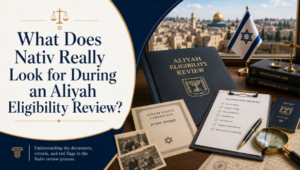
Depending on the circumstances, supporting evidence may include:
- birth and marriage certificates,
- Soviet archival records,
- census records,
- military records,
- cemetery and burial documentation,
- synagogue letters,
- family immigration files,
- Holocaust-related records,
- rabbinical opinions,
- genealogical reports,
- and affidavits from relatives or community members.
Complex cases often require combining multiple forms of evidence to establish eligibility.
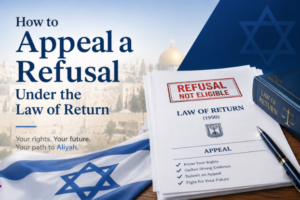
Can an Aliyah Refusal Based on Proof Issues Be Appealed?
Yes. Many proof-of-Judaism denials can be challenged through:
- supplemental submissions,
- administrative appeals,
- legal argumentation,
- and additional documentary evidence.
In some cases, the issue is not a lack of eligibility, but rather insufficient presentation or incomplete evidentiary organization.
How Our Office Assists in Complex Proof-of-Judaism Cases
Our office assists clients with:
- reconstruction of family histories,
- analysis of eligibility under the Law of Return,
- preparation of supporting documentation,
- communication with Nativ and Israeli authorities,
- appeals following Aliyah refusals,
- and strategic presentation of complex evidence.
We work with individuals and families in Israel and abroad facing difficult documentation challenges and sensitive immigration issues.
Legal Guidance for Aliyah Cases Involving Missing Jewish Documentation
Proof-of-Judaism cases are often highly fact-specific and require strategic legal preparation.
If your Aliyah application was delayed, questioned, or denied due to insufficient proof of Jewish heritage, our office can review the available documentation and evaluate the legal options available under Israeli immigration law.