
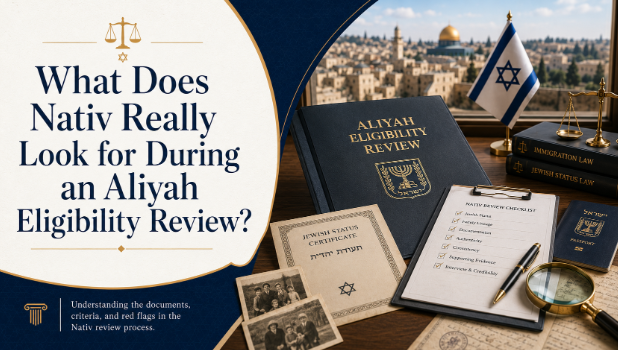
Understanding the Nativ Eligibility Review Process
Many individuals applying for Aliyah are unfamiliar with the role Nativ plays in evaluating eligibility under the Law of Return. Applicants are often surprised when they are asked for additional documents, referred for interviews, or subjected to prolonged review processes.
In practice, Nativ examines far more than whether an applicant simply claims Jewish ancestry.
Our office assists clients worldwide with complex Aliyah applications, including cases involving heightened scrutiny, documentary inconsistencies, conversion issues, and referrals for additional review by Nativ or the Israeli Ministry of Interior.
What Is Nativ?
Nativ is the Israeli governmental body responsible for reviewing many Aliyah applications, particularly those originating from the former Soviet Union and related regions.
Its role typically involves evaluating:
- eligibility under the Law of Return,
- authenticity of documents,
- Jewish lineage claims,
- and factual consistency within the application.
What Does Nativ Examine During an Eligibility Review?
Proof of Jewish Heritage
One of the primary areas of review involves whether the applicant adequately established:
- Jewish identity,
- descent from a Jewish parent or grandparent,
- or another qualifying connection under the Law of Return.
Consistency of Family Documentation
Nativ carefully reviews:
- birth certificates,
- marriage records,
- passports,
- nationality entries,
- and historical family records.
Even relatively minor discrepancies may trigger requests for clarification.
Conversion-Related Issues
Where Aliyah is based on conversion, authorities may review:
- the legitimacy of the conversion process,
- rabbinical supervision,
- communal involvement,
- and supporting evidence.
Credibility and Authenticity Concerns
Authorities may examine whether:
- documents appear authentic,
- timelines make sense,
- and the overall application presents a coherent factual history.
Why Are Applicants Asked for Additional Documents?
Requests for additional evidence are common and do not necessarily mean the application will be denied.
Israeli authorities may request supplemental documentation where:
- records are incomplete,
- inconsistencies exist,
- archival verification is needed,
- or the evidentiary chain is unclear.
However, poorly handled responses can create further complications.
Common Red Flags in Aliyah Reviews
Cases may receive heightened scrutiny where there are:
- inconsistent family names,
- conflicting nationality records,
- missing Soviet-era documents,
- prior immigration violations,
- questionable conversion documentation,
- or concerns regarding fraud or authenticity.
How Our Office Assists in Nativ Review Cases
Our office assists clients with:
- preparation of Aliyah applications,
- evidentiary analysis,
- responses to requests for additional documentation,
- preparation for interviews,
- appeals following refusals,
- and strategic legal guidance in complex Law of Return matters.
We work closely with individuals and families facing sensitive documentation and eligibility issues before Israeli immigration authorities.
Legal Guidance for Complex Aliyah Eligibility Reviews
Nativ reviews are often detailed, technical, and highly fact-specific. Early legal preparation can significantly reduce delays and strengthen the overall application.
If your Aliyah application was referred for additional review, delayed, or questioned by Israeli authorities, our office can evaluate the case and help develop a strategic legal approach tailored to your circumstances.