Can Individuals With Reform or Conservative Conversions Make Aliyah?
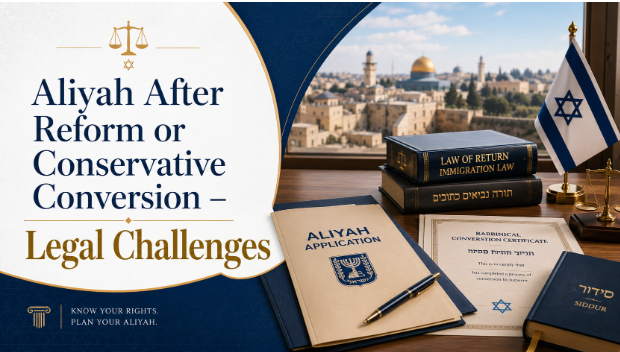
Aliyah cases involving Reform and Conservative conversions are among the most legally complex matters under Israeli immigration law. Although Israeli courts have recognized certain non-Orthodox conversions for purposes of the Law of Return, many applicants still face significant procedural and evidentiary challenges.
Israeli authorities frequently examine:
- where the conversion occurred,
- which rabbinical body supervised the process,
- whether the conversion is recognized,
- and whether the applicant genuinely joined a Jewish community.
Our office represents individuals and families in complex conversion-based Aliyah cases, including refusals, delays, and appeals involving Reform and Conservative conversions.
Are Reform and Conservative Conversions Recognized in Israel?
Under Israeli law and Supreme Court precedent, certain Reform and Conservative conversions may qualify an individual for Aliyah and Israeli citizenship under the Law of Return.
However, recognition depends on the specific circumstances of the case.
Not every conversion is automatically accepted, and Israeli authorities may closely review:
- the conversion process,
- community participation,
- rabbinical supervision,
- and supporting documentation.
Why Do Reform and Conservative Conversion Cases Face Scrutiny?
Israeli immigration authorities often treat non-Orthodox conversion cases as complex applications requiring additional review.
Common concerns include:
- private or unofficial conversions,
- insufficient evidence of Jewish communal involvement,
- short conversion timelines,
- missing documentation,
- or suspicion that the conversion was performed solely for immigration purposes.
Applications may also encounter complications where:
- the converting rabbi is unfamiliar to Israeli authorities,
- the conversion institution lacks established recognition,
- or prior religious history creates inconsistencies in the file.
Important Documents in Conversion-Based Aliyah Cases
Applicants may be asked to provide:
- conversion certificates,
- letters from rabbis,
- synagogue membership records,
- proof of Jewish studies,
- evidence of ongoing community participation,
- civil status documents,
- and apostilled records.
In many cases, additional legal explanations and supporting evidence are necessary.
Can a Reform or Conservative Conversion Aliyah Case Be Denied?
Yes. Israeli authorities may deny applications if they believe:
- the conversion does not meet legal requirements,
- the evidence is insufficient,
- or the applicant failed to establish genuine Jewish communal integration.
However, many denials can be challenged through legal appeals and strategic evidentiary submissions.
Appeals in Non-Orthodox Conversion Cases
Israeli courts have issued important rulings involving recognition of Reform and Conservative conversions under the Law of Return.
Depending on the circumstances, applicants may pursue:
- requests for reconsideration,
- administrative appeals,
- or judicial review proceedings.
Successful appeals often require detailed legal analysis combined with carefully prepared factual evidence.
How Our Office Assists in Reform and Conservative Conversion Cases
Our office assists clients with:
- evaluation of conversion recognition issues,
- preparation of Aliyah applications,
- legal submissions and supporting documentation,
- appeals following refusals or delays,
- and representation before Israeli immigration authorities.
We work with individuals and families worldwide navigating sensitive conversion-related immigration matters under Israeli law.
Legal Assistance for Conversion-Based Aliyah Applications
Conversion-related Aliyah cases often involve evolving legal standards, administrative discretion, and complex factual questions.
If you completed a Reform or Conservative conversion and wish to immigrate to Israel, our office can evaluate your eligibility and help build a strategic application or appeal under the Law of Return.